The East African region is undergoing one of the most significant economic transformations in its history, with population growth, urbanisation, digital innovation, infrastructure expansion, and regional integration creating unprecedented opportunities.
The growth requires capital, and KCB Group through its subsidiary, KCB Investment Bank is at the heart of is at the heart of this journey.
When KCB Capital rebranded to KCB Investment Bank in January 2023, the vision and strategic intent were to align the brand with the full breadth of services that KCB Group provides in the region and to ensure that the market clearly recognises KCB Investment Bank’s broader mandate across advisory, brokerage, and wealth management services.
For starters, investment banks act as architects of complex deals that help businesses raise capital, expand, acquire, and transform. They do this by designing financial structures that turn future or irregular cash flows into usable capital, combining debt and equity in smart ways, and ensuring every transaction is sound financially and legally.
A good investment bank wears three hats at once: that of a financial expert, lawyer, and accountant, to ensure that investors are confident that their risks are covered while businesses get long-term, stable funding for growth.
In East Africa, sophisticated financial solutions are becoming increasingly important as the region is evolving into a large, integrated economic bloc, with a population of over 350 million people and a growing cross-border trade.
As infrastructure like roads, rail, and ports improves, and initiatives such as the African Continental Free Trade Area (AfCFTA) arrangement and the use of local currencies continue to open trade corridors, businesses need more advanced ways to raise and structure capital for large projects.
KCB Group, through KCB Investment Bank, sees its role as a designer and mobiliser for complex funding structures such as project finance, securitisation, sustainability bonds, and syndications, using local and regional pools of capital such as pension funds, to facilitate the region’s economies to fund large-scale growth from within rather than relying only on external players.
East Africa’s Growth & Investment Potential
The region is experiencing a modest but steady economic growth, with the economy expanding at around 4.5% - 5.5% annually. This growth is underpinned by increasing regional integration, where businesses in countries like Kenya, Tanzania, Rwanda, and Uganda are actively investing across borders.
Additionally, key trade and transport corridors such as the Standard Gauge Railway (SGR), the LAPSSET project, and the East African Community (EAC) are strengthening connectivity and enabling more seamless movement of goods, services, and capital across the region.
The region is also experiencing a youthful, tech-savvy population. About 70% of the population is under the age of 18, creating a powerful demographic engine for future growth. This population is highly digital, rarely wants to visit banking halls, and shows a strong appetite for new investment classes such as virtual assets. For instance, in 2025, Kenya traded close to US$ 3 billion in virtual assets.
This is pushing financial institutions and markets to rethink their business models. At the same time, interest rates have been easing, and capital is increasingly flowing into corporate issuances, shifting attention away from purely government securities toward private sector opportunities. As a result, capital markets are emerging as a critical accelerator of growth.
Globally, about 90% of business funding comes from capital markets, while in East Africa, 70 -80% of funding is still concentrated in commercial banks’ balance sheets. To close this gap, there is a need to develop deeper markets for corporate bonds, equity, and structured products, so that banks and capital markets can jointly support business expansion instead of relying solely on banks.
In addition, harmonised regulations across East Africa's capital markets now make it easier for issuers to raise funds regionally and for investors to allocate a portion of their portfolio’s assets, effectively creating a larger, integrated pool of capital within the bloc.
Moreover, securitisation is standing out as one of the most powerful tools capital markets are using to accelerate growth. By packaging future cash flows from sectors such as logistics, healthcare, and even loan books within financial institutions, securitisation can transform long-term receivables into upfront capital.
This approach allows governments and corporates to finance long-term infrastructure like roads, ports, airports, and stadiums, using domestic and regional savings thus easing fiscal pressure and reducing the dependence on expensive external borrowing.
Future Outlook
The East African region is on the verge of a major economic upsurge, with the next decade being seen as a decisive period in which it can cement itself as a leading growth hub. The foundation for this outlook lies in steady economic expansion, increasing regional integration and a large, youthful, tech-driven population that is beginning to influence how markets operate.
Infrastructure projects are emerging as a critical enabler for realising this vision. They are being seen as essential in unlocking trade, attracting investments and linking the region more efficiently to global markets. The region’s heavy dependence on bank lending is identified as a constraint, and a shift towards deeper, more dynamic capital markets, with greater use of corporate bonds, equity issues, and structured financing, is presented as key to scaling private sector growth. In addition, local financial sector players are encouraged to step up into spaces often dominated by external investors, including early-stage funding and venture capital. This will ensure local ideas are built and scaled from within.
The writer is the Managing Director, KCB Investment Bank
--------------------------------------------------------------------------------------------------------------------
The Architect of Landmark Deals
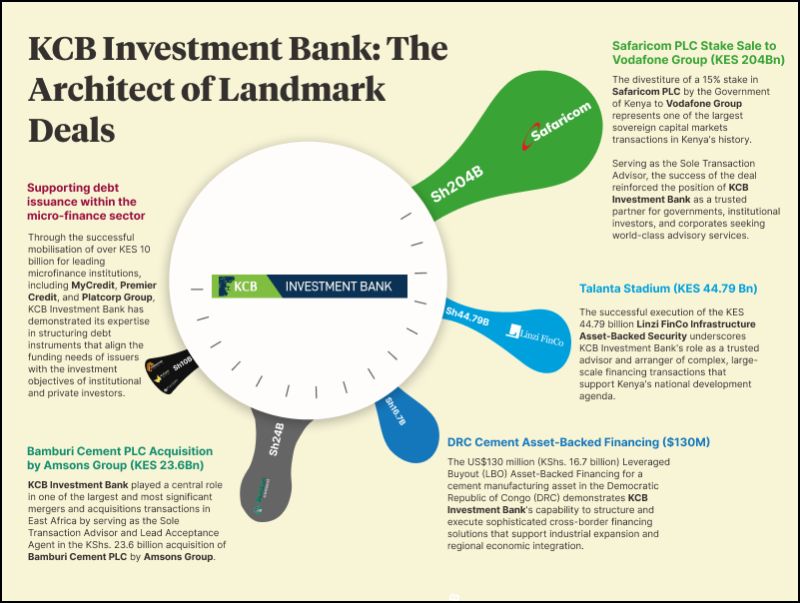
Over the years, KCB Investment Bank has played a pivotal role in structuring and executing some of East Africa's most significant transactions, helping governments, businesses and investors unlock capital, and create long-term value. From mergers and acquisitions and corporate restructurings to debt and equity capital raising, real estate investment trusts (REITs), and strategic financial advisory, the Bank has consistently delivered solutions that fuel inclusive growth.
- Bamburi Cement PLC Acquisition by Amsons Group (KES 23.6Bn)
KCB Investment Bank played a central role in one of the largest and most significant mergers and acquisitions transactions in East Africa by serving as the Sole Transaction Advisor and Lead Acceptance Agent in the KES 23.6 billion acquisition of Bamburi Cement PLC by Amsons Group.
- Talanta Stadium (KES 44.79 Bn)
The successful execution of the KES 44.79 billion Linzi FinCo Infrastructure Asset-Backed Security underscores KCB Investment Bank's role as a trusted advisor and arranger of complex, large-scale financing transactions that support Kenya's national development agenda.
- DRC Cement Asset-Backed Financing ($130M)
The $130 million (KES 16.7 billion) Leveraged Buyout (LBO) Asset-Backed Financing for a cement manufacturing asset in the Democratic Republic of Congo (DRC) demonstrates KCB Investment Bank's capability to structure and execute sophisticated cross-border financing solutions that support industrial expansion and regional economic integration.
- Nation Media Group PLC Acquisition by Taarifa Ltd
As the Sole Transaction Advisor to Taarifa Ltd, KCB Investment Bank played a central role in originating, structuring, and executing the acquisition of a 54.08% controlling stake in Nation Media Group PLC. The transaction sets the foundation to facilitate cross-border investment and enable businesses to evolve and compete in a rapidly changing economic landscape.
- Safaricom PLC Stake Sale to Vodafone Group (KES 204Bn)
The divestiture of a 15% stake in Safaricom PLC by the Government of Kenya to Vodafone Group represents one of the largest sovereign capital markets transactions in Kenya's history. Serving as the Sole Transaction Advisor, the success of the deal reinforced the position of KCB Investment Bank as a trusted partner for governments, institutional investors, and corporates seeking world-class advisory services.
- Supporting debt issuance within the micro-finance sector
Through the successful mobilisation of over KShs. 10 billion for leading microfinance institutions, including MyCredit, Premier Credit, and Platcorp Group, KCB Investment Bank has demonstrated its expertise in structuring debt instruments that align the funding needs of issuers with the investment objectives of institutional and private investors.